
Lyonel Feininger (1871–1956)
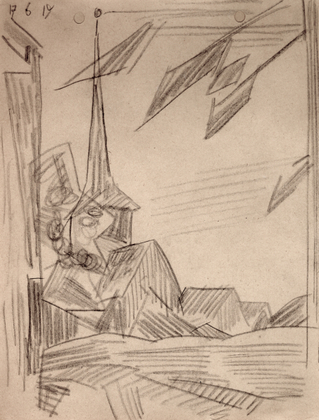
(Gelmeroda), 1919
Pencil on paper
8 1/8 x 6 1/4 in. (20.6 x 15.9 cm)
Dated upper right: 17 6 19

Here we highlight nine extraordinary pencil and crayon sketches by Lyonel Feininger (1871–1956), made between 1913 and 1919, and centered on a recurring motif in his work: the church of Gelmeroda. These sketches come from the collection of the distinguished art historian and museum director Alois J. Schardt (1889–1955).
Feininger first discovered the village of Gelmeroda, and its church with its distinctive slender steeple, in 1906. He was there to visit his love (and future wife), Julia Berg, who was studying at the Grand Ducal Saxon School of Visual Arts. Captivated by the village, Feininger returned to it frequently during extended stays in Weimar in 1913 and 1914, and following his appointment as master at the Bauhaus in Weimar in 1919. He captured Gelmeroda in numerous sketches, or “nature studies,” as he called them. He would ultimately enshrine the church in 13 paintings, testament to the depth of his fascination with this structure. As the art historian Martin Faass observed: “Again and again Gelmeroda! Over and over the pointy spire with the asymmetric fitted dial, sometimes from the east, other times from the north. Again and again this Thuringian village church. No other motif occupied Lyonel Feininger as much as the church of Gelmeroda….”
Ranging from expressionistic to cubistic, the drawings reveal Feininger’s mastery as a draftsman, and the joy he took in his subject. In 1913, he wrote to Julia: “In the afternoon, armed with my umbrella and a pad, I toddled out to Gelmeroda. For one-and-a-half hours I sketched around the church which is just wonderful. When, finally, I started on my way home, instead of being tired and worn out I felt refreshed and full of elasticity."
Lyonel Feininger (1871–1956)
(Gelmeroda), 1919
Pencil on paper
8 1/8 x 6 1/4 in. (20.6 x 15.9 cm)
Dated upper right: 17 6 19

Lyonel Feininger (1871–1956)
(Gelmeroda), 1919
Crayon on paper
11 1/8 x 8 1/2 in. (28.3 x 21.6 cm)
Dated upper right: 13 VI 19

Lyonel Feininger (1871–1956)
(Church and Graveyard, Gelmeroda), 1913
Pencil on paper
7 7/8 x 6 1/4 in. (20 x 15.9 cm)
Dated upper right: 14 V 13

Lyonel Feininger (1871–1956)
(Church with Trees, Gelmeroda), 1914
Crayon on paper
8 x 6 1/4 in. (20.3 x 15.9 cm)

Lyonel Feininger (1871–1956)
(Gelmeroda), 1919
Pencil on paper
6 1/4 x 8 1/8 in. (15.9 x 20.6 cm)
Dated upper right: 17 6 19
Lyonel Feininger (1871–1956)
(Gelmeroda), 1919
Pencil on paper
8 x 6 1/4 in. (20.3 x 15.9 cm)
Dated upper left: 17 6 19

Church of Gelmeroda, North View, 1930
Photo: Thüringisches Landesamt für Denkmalpflege
And recently, here—in Gelmeroda, in Vollersroda, Mellingen, Taubach, in many places—still larger, bolder images have opened themselves to me; I’ll soon be tackling those! That I could at the same time absorb and create was something I had hardly dared to hope for until now! But it is so, and it will grow ever stronger within me. This is surely the first period of maturity in my life as an artist.
—Lyonel Feininger, 1913

Lyoenl Feinigner on his bicycle, 1926
Photo: T. Lux Feininger
1871
Lyonel Feininger is born on July 17 in New York to Karl and Elizabeth Feininger; he is the first of three children.
1887
Leaves for Germany and starts studying at the General Vocational and Crafts School in Hamburg.
1888
Moves to Berlin and begins studying at the Royal Academy of Arts.
1892
Leaves the Academy and moves to Paris.
1893
Moves back to Berlin and starts working as a freelance cartoonist and illustrator.
1901
Marries Clara Fürst, birth of daughter Eleonora.
1902
Birth of daughter Marianne.
1905
Meets Julia Berg (née Lilienfeld) and separates from his wife.
1906
Moves with Julia to Paris and their son Andreas is born. Works on two comic strips for The Chicago Sunday Tribune.
1907
Executes his first oil painting.
1908
Marries Julia in London, returns to Berlin.
1909
Birth of son Laurence.
1910
Birth of son Theodore Lux (T. Lux).
1911
Six paintings are shown at the Salon des Indépendants in Paris.
1913
Five paintings are shown at the Erster Deutscher Herbstsalon, organized by the Galerie Der Sturm in Berlin.
1917
First solo exhibition at the Galerie Der Sturm.
1919
Is appointed the first master of the Staatliches Bauhaus in Weimar.
1921
Composes his first fugue.
1926
Moves with the Bauhaus to Dessau as master without teaching duties.
1929
Works on a series of paintings for the City of Halle (Saale).
1931
Completes his Halle series. Retrospectives in Dresden, Essen, and at the Nationalgalerie in Berlin.
1934
Moves to Berlin-Siemensstadt.
1935
The National Socialists declare his art “degenerate.”
1936
Teaches a summer course at Mills College in Oakland, California.
1937
Leaves Germany, teaches another summer course at Mills College and then settles in New York City.
1939
Works on murals for the 1939/1940 New York World’s Fair.
1942
One of his paintings is awarded a purchase prize by the Metropolitan Museum of Art in New York.
1944
Retrospective with Marsden Hartley at The Museum of Modern Art in New York.
1945
Teaches a summer course at Black Mountain College in Asheville, North Carolina.
1956
Dies on January 13 in his New York apartment.